Anaerobic Digestion & Biogas
A natural clinoptilolite guide that sequesters digestate NH₄⁺ through cation exchange of CEC 1.6–2.0 meq/g to buffer free-ammonia inhibition (direct digester dosing 14×40–8×14 mesh, review dose 10–30 g/L), and separates particle size by design down to downstream 4×8 mesh scrubbing for biogas H₂S/CO₂ purification.
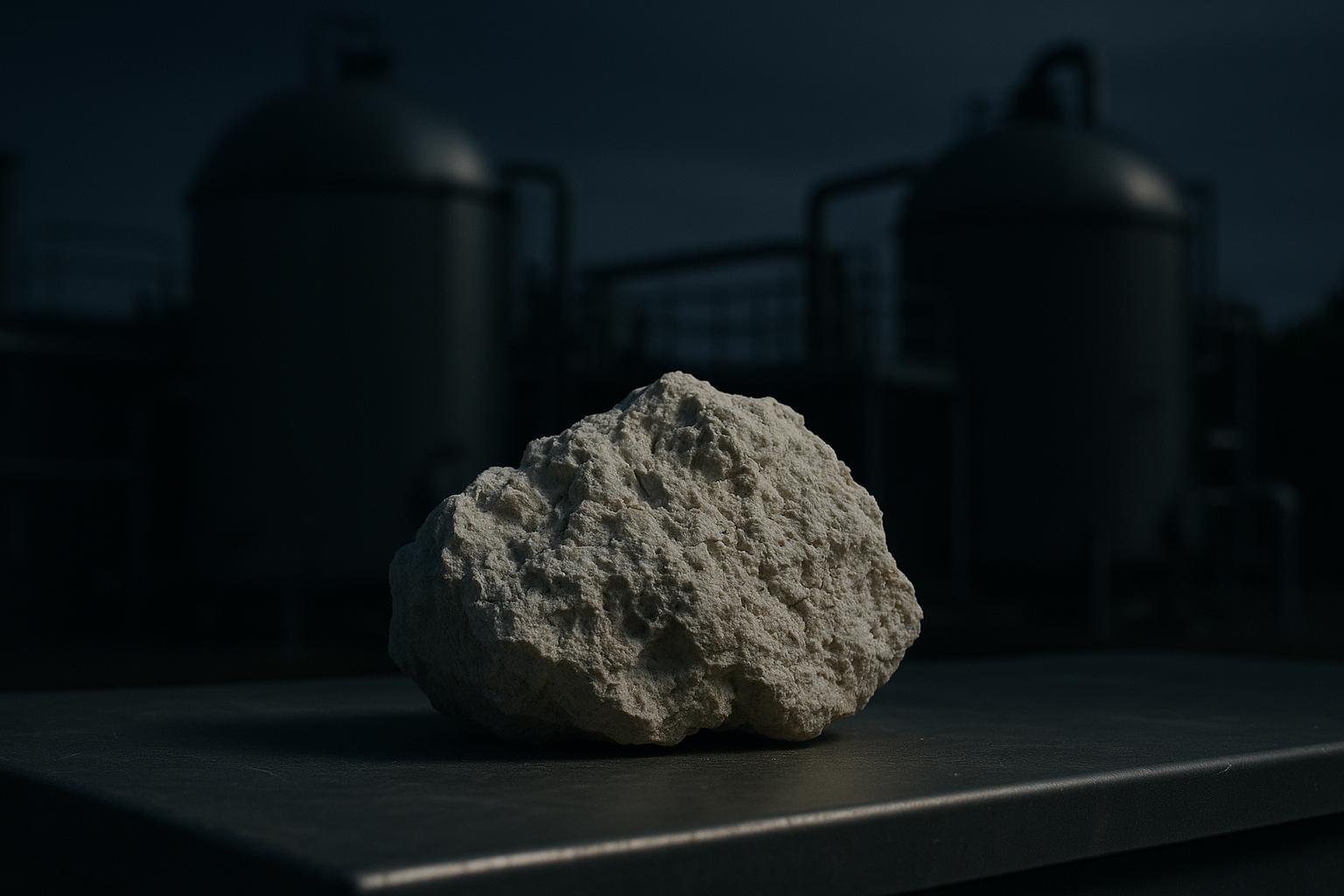
Natural Clinoptilolite Zeolite for Anaerobic Digestion & Biogas
The real problem in digester operation: ammonia inhibition
When nitrogen-rich substrates such as livestock manure, poultry litter, or food waste are mono-digested anaerobically, total ammoniacal nitrogen (TAN) accumulates during protein degradation. In the field, once TAN exceeds 3,000–5,000 mg/L, methanogens (especially acetoclastic methanogens) are inhibited, volatile fatty acids (VFA) accumulate, the VFA/alkalinity ratio rises above 0.4, the digester tips toward "souring," and the daily specific methane yield (SMP) plummets. Free ammonia (FAN, NH₃) is sensitive to pH and temperature, so at thermophilic (55°C) digestion the same TAN causes inhibition faster than at mesophilic (35–38°C) conditions, creating operating constraints where the OLR (organic loading rate) cannot be raised to the design value and the HRT (retention time) must be drawn out.
In other words, the core challenge in this field is not simple deodorization but "buffering the NH₄⁺-NH₃ equilibrium inside the digester to protect the active range of methanogens." This is precisely why natural clinoptilolite is under review.
Why clinoptilolite works in a digester
The framework of clinoptilolite is a negatively charged aluminosilicate channel structure that selectively captures NH₄⁺ through a cation-exchange capacity of CEC 1.6–2.0 meq/g. Even among the Na⁺, K⁺, Ca²⁺, and Mg²⁺ abundantly present in digestate, it has high selectivity for NH₄⁺ (ionic radius about 1.43 Å), so ammonium that passes through channel openings of 4.0–7.0 Å is fixed at exchange sites within the framework. Sequestering some of the dissolved NH₄⁺ this way shifts the NH₄⁺↔NH₃ equilibrium, lowering the concentration of strongly inhibitory free ammonia, while the exchanged cations replenish alkalinity and contribute to pH buffering (stable range 3.0–10.0). In addition, the porous surface with a specific surface area of 40.0 m²/g and pore volume of about 50% serves as a biofilm carrier onto which methanogens can attach and accumulate, with reported effects of retaining slow-growing, washout-prone microorganisms inside the digester.
Key properties
| Item | Value | Biogas application significance |
|---|---|---|
| CEC | 1.6–2.0 meq/g | Ammonia buffering |
| Specific surface area | 40.0 m²/g | Microbial attachment surface |
| pH stable range | 3.0–10.0 | Handles digester pH fluctuation |
| Pore diameter | 4.0–7.0 Å | Molecular-level selective adsorption |
| Hardness | 4.0–5.0 Mohs | Abrasion resistance in mixing environments |
Suitable particle sizes
| Product name | Mesh | Particle size | Application method |
|---|---|---|---|
| KMI 14×40 | 14×40 mesh | 0.4–1.4mm | Digester dosing, packed bed |
| KMI 8×14 | 8×14 mesh | 1.4–2.4mm | Large digester packing |
| KMI 4×8 | 4×8 mesh | 2.4–4.8mm | Air scrubber, gas purification |
Research basis: measured results in biogas processes
Studies that applied clinoptilolite directly to anaerobic digestion have been reported. Garuti, M. et al. (2020), Materials observed a trend of improved biogas production in the clay-mineral-amended group when clinoptilolite and halloysite were added to a batch anaerobic-digestion test, and interpreted that the minerals simultaneously perform ammonia buffering and microbial-carrier functions. In other words, it suggests potential as a "process-stabilizing additive" rather than an "adsorbent."
For a comprehensive process-oriented review, Al-Mamoori, A. et al. (2024), Cogent Engineering summarized pathways using natural zeolite in both stages of (1) mitigating ammonia inhibition via dosing into the digester and (2) purifying the produced biogas (biomethane upgrading through CO₂/H₂S removal). The coarse 4×8 mesh particles of this product being placed in gas-purification/air-scrubber packed beds also aligns with this second pathway.
As basic data on ammonium capture, Sprynskyy, M. et al. (2005), Journal of Colloid and Interface Science quantified the NH₄⁺ sorption behavior of Transcarpathian natural clinoptilolite and showed that preferential exchange for ammonium occurs even in multi-component solutions where Na⁺, K⁺, Ca²⁺, and Mg²⁺ coexist. The equilibrium NH₄⁺ adsorption capacity of natural clinoptilolite is reported in the literature at roughly 8–20 mg NH₄⁺/g (varying with pretreatment, source, and temperature), and this value becomes a design benchmark for gauging the upper limit of ammonium that can be sequestered per unit mass inside the digester. This provides the mechanistic basis that NH₄⁺ selectivity is maintained even in a cation-rich digestate environment.
Behavior under packed-bed flow-through conditions can be confirmed in Mažeikienė, A. et al. (2008), Journal of Environmental Engineering and Landscape Management. When a 10–15 mg/L ammonium solution was passed through a packed bed of 0.315–0.63 mm particles (bed height about 400 mm), an ammonium removal efficiency of 72–99.9% was observed under both static and dynamic conditions, and the removal rate rose as the flow velocity decreased (the longer the EBCT). When designing a digestate NH₄⁺-recovery packed bed downstream of the digester, this particle-size–bed-height–retention-time (EBCT) relationship serves as a direct primary basis.
Application methods and operating-condition guide
Direct digester dosing (ammonia buffering)
In completely-mixed (CSTR) digesters, 14×40 mesh (0.4–1.4mm) or 8×14 mesh (1.4–2.4mm) is used to balance suspension and settling behavior during mixing. In the literature, the dose is reviewed roughly in the 10–30 g/L range relative to the digesting slurry (on a VS basis), and the higher the nitrogen load—as in poultry- or pig-manure mono-digestion—the higher the upper-end concentration is considered. The dose is not determined by a simple proportion but by first estimating from a mass balance between the target TAN reduction and the NH₄⁺ adsorption capacity of clinoptilolite (about 8–20 mg/g), then calibrating the response on the actual substrate via a BMP batch test—a reasonable procedure. Powder (100 mesh or finer) has a large external surface area per unit mass, so its initial adsorption rate is fast, but it is hard to recover from the slurry, so it is selected when premised on linkage to digestate resource recovery (return as slow-release fertilizer).
Packed bed / biofilm carrier
In UASB and fixed-bed reactors, 8×14 or 4×8 mesh is used as packing material to establish a methanogen biofilm and operate in a direction that reduces microbial washout even at high OLR. The porous surface with about 40 m²/g specific surface area and about 50% pore volume provides attachment substrate for slow-growing organisms such as acetoclastic methanogens, helping increase the active biomass per unit volume. When operating a separate digestate NH₄⁺-recovery packed bed, apply the particle-size–bed-height–EBCT relationship confirmed in flow-through tests (coarser particles have lower pressure loss but require a longer EBCT to achieve the same removal rate) to jointly design the bed height and flow velocity. With a hardness of 4.0–5.0 Mohs, it is relatively resistant to abrasion in mixing and flow-through environments.
Biogas purification (upgrading)
In the gas-purification scrubber downstream of the digester, coarse 4×8 mesh (2.4–4.8mm) particles are charged to adsorb H₂S, moisture, and some CO₂, supporting biomethane quality. To reduce pressure loss, the coarse particle size and bed height are designed together.
Linkage to digestate and digestion by-product recovery
Zeolite that has captured NH₄⁺ can, after separation and recovery following digestion, be returned to farmland as a nitrogen-bearing, slow-release soil amendment. OMRI Listed (KMI-10365) natural clinoptilolite is permitted as an organic soil material, enabling review of linkage to a digester-to-cropland circular design.
Field review points
- Because particle size and dose change with the substrate's nitrogen content (C/N ratio) and target TAN buffering amount, verify in advance with a BMP (biochemical methane potential) batch test
- Effects vary greatly with mesophilic/thermophilic operation, OLR, HRT, and mixing intensity — do not generalize from single-condition results
- Design together with in-digester settling/scum, pump/mixer abrasion, and recovery method (screening/sedimentation)
- The extent of methane-yield increase is dependent on substrate and operating conditions and cannot be stated definitively without on-site pilot data
Frequently Asked Questions (FAQ)
Q. How much does methane yield increase when zeolite is added?
The quantitative increase varies greatly with substrate and operating conditions and cannot be stated definitively. Garuti et al. (2020) reported a biogas-enhancement trend in the clay-mineral-amended group, but that was the result of specific batch conditions. The higher the ammonia level in a digester where nitrogen inhibition actually occurs, the greater the room for a buffering effect, so we recommend first confirming the response of your own substrate through a BMP batch test.
Q. Does zeolite saturate quickly with adsorbed ammonium, requiring frequent replacement?
Zeolite inside a digester acts not as a one-time adsorbent but as an NH₄⁺-NH₃ equilibrium buffer and microbial carrier, so replacement is not judged by saturation point alone. However, exchange capacity gradually declines over long-term operation, so a circular operation of recovering it, reusing it as a soil amendment, and replenishing with fresh material is reasonable. The replacement cycle is determined by monitoring TAN trends and VFA/alkalinity.
Q. Which is correct — using it in the digester body or in gas purification?
The two pathways serve different purposes. Direct dosing into the digester aims at mitigating ammonia inhibition and stabilizing the process, so 14×40–8×14 mesh is used; gas purification (H₂S/CO₂ removal) charges coarse 4×8 mesh particles into a downstream scrubber. As Al-Mamoori et al. (2024) summarized, a design combining both uses is also possible, with each operated using a separate particle size and dosing location.
Q. How is the dose calculated? Is there an NH₄⁺ adsorption-capacity figure?
The equilibrium NH₄⁺ adsorption capacity of natural clinoptilolite is reported in the literature at roughly 8–20 mg NH₄⁺/g (depending on source, pretreatment, and temperature). The first-pass estimate starts from a mass balance of "target TAN reduction × slurry volume ÷ adsorption capacity," but since Na⁺, K⁺, Ca²⁺, and Mg²⁺ coexist in the digestate and cause competitive exchange, it is safer to set the actual effective capacity below this upper limit. In the field, we recommend calibrating the response with a BMP batch test in the 10–30 g/L dosing range before finalizing the full-process concentration.
Notice
Zeolite for anaerobic digestion and biogas can be reviewed from the perspective of a process-auxiliary material. Actual application, dose, and particle size should be decided based on feedstock nitrogen content, operating temperature, OLR/HRT, and pilot results.
Related pages: Manure & Compost Odor Management · Environmental Remediation & Adsorption · Wastewater Treatment
science Related Papers
Academic papers addressing zeolite application in this field. Please refer to them when reviewing adoption.
- Effect of Clinoptilolite and Halloysite on Biogas Production during Anaerobic Digestion
Garuti, M. et al. — Materials, 2020 - Natural zeolites for optimized biogas, syngas, and hydrogen production and purification
Al-Mamoori, A. et al. — Cogent Engineering, 2024 - Ammonium sorption from aqueous solutions by natural zeolite Transcarpathian clinoptilolite
Sprynskyy, M. et al. — Journal of Colloid and Interface Science, 2005 - Use of natural zeolite (clinoptilolite) in the reduction of ammonia from livestock environments
Mumpton, F.A. and Fishman, P.H. — Clays and Clay Minerals, 1977 - Amendment of Livestock Manure with Zeolite-Clinoptilolite and Effect on Composting
Subova, E. et al. — Agriculture, 2021 - Removal of nitrates and ammonium ions from water using natural sorbent zeolite (clinoptilolite)
Mažeikienė, A. et al. — J. Environmental Engineering and Landscape Management, 2008
The papers above are reference material; actual application requires separate review tailored to on-site conditions.