Zeolite for Rooftop Garden Media
Lightweight rooftop media (perlite, coco peat) built to minimize load have weak water-holding and nutrient retention; blending natural clinoptilolite with CEC 1.6–2.0 meq/g and 4.0–7.0 Å pores at 10–20% by volume temporarily holds water and NH₄⁺/K⁺ after irrigation and releases them gradually, easing drought and nutrient runoff at the same time — provided the blend ratio is set within the load limit, since its specific gravity is 1.89.
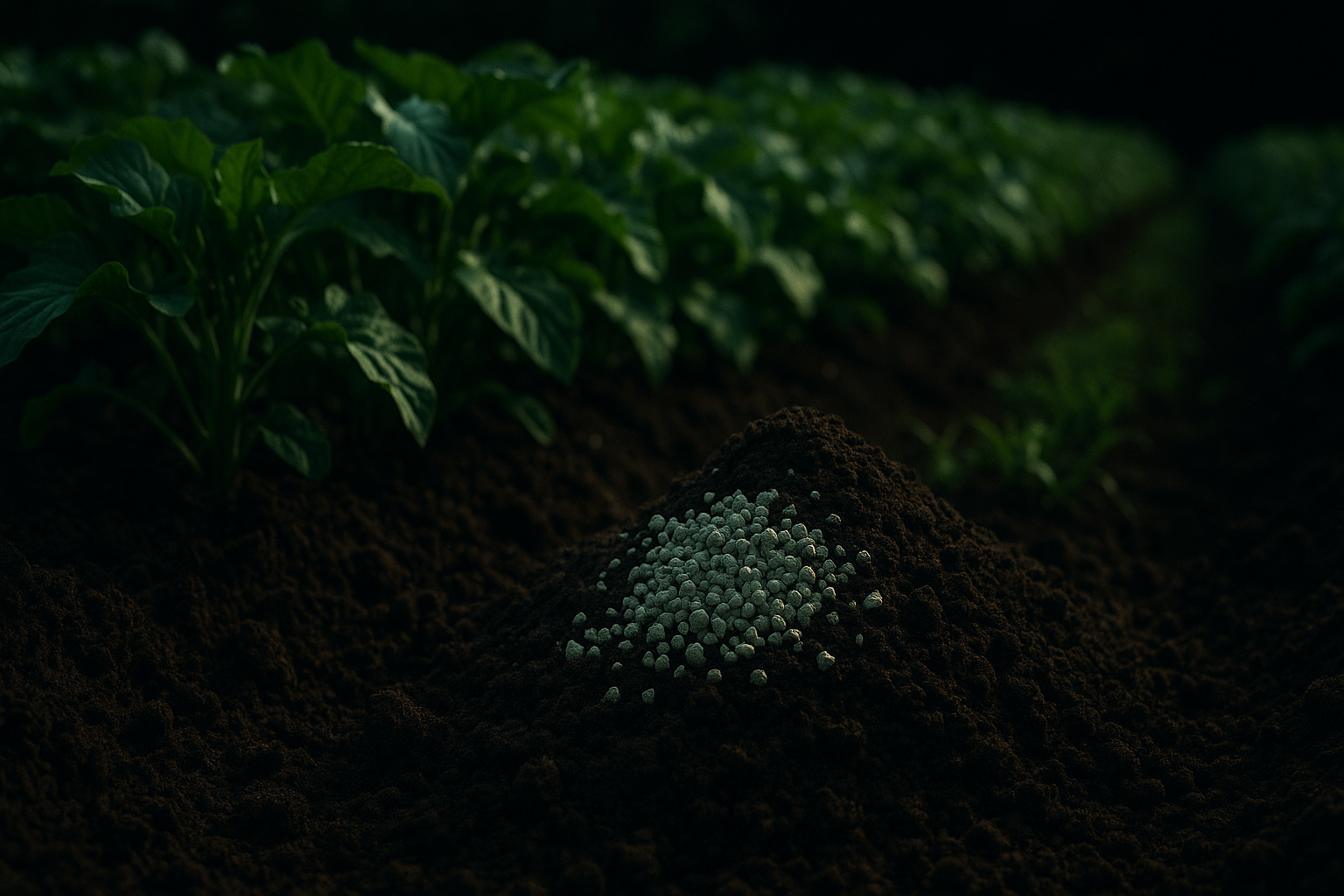
Rooftop Garden Media: What Is the Problem?
Media for rooftop gardens and rooftop vegetable plots cannot simply use ordinary field soil because of the building's structural load limits. They are therefore blended mainly from lightweight materials such as perlite, coco peat, and peat moss. These lightweight media are light and drain well, but they have a limitation: weak water-holding (moisture retention) and nutrient retention capacity (CEC). Perlite is chemically nearly inert, so its cation exchange capacity is close to zero, and the organic CEC of coco peat and peat moss also gradually declines as they decompose.
As a result, in summer the rooftop dries quickly under radiant heat and wind, and right after irrigation fertilizer nutrients flow out with the water to the drains, making frequent irrigation and top-dressing necessary. In particular, rooftops have a shallow planting layer (often 10–25cm) and drainage leads directly to rain gutters and stormwater pipes, so in the shallow root zone a single bout of excessive irrigation or rainfall washes out NH₄⁺, NO₃⁻, and K⁺ as is. This is both a waste of fertilizer and a contribution to eutrophication of nearby waterways. Ultimately, a "lightweight yet water- and nutrient-holding" mineral amendment is needed.
Why Zeolite Is Considered for Rooftop Media
Natural clinoptilolite zeolite is a mineral that simultaneously possesses a 4.0–7.0 Å micropore structure and a cation exchange capacity (CEC 1.6–2.0 meq/g). The permanent negative charge created as aluminum enters the framework is the essence of CEC, and NH₄⁺ and K⁺ are selectively adsorbed at these sites — clinoptilolite's cation preference is known to be roughly K⁺ > NH₄⁺ > Ca²⁺ > Na²⁺, which is advantageous for preferentially capturing the key fertilizer nutrients potassium and ammonium. At the same time, its micropores and pore volume (about 50%) temporarily hold irrigated water by capillary force and release it for plants to use slowly. In other words, a single material compensates for the two things lightweight media easily lose (moisture and nutrients).
These two functions are also repeatedly confirmed in the literature. Ramesh & Reddy (2017, Water, Air, & Soil Pollution) summarized that zeolite's high CEC and porosity improve soil water and nutrient retention and fertilizer use efficiency, and Gul et al. (2005, Scientia Horticulturae) presented a comparison in lettuce cultivation showing that clinoptilolite media are more favorable for nutrient retention than chemically inert perlite media — a directly relevant comparison given that perlite is the representative material of lightweight rooftop media. Ferguson et al. (1986, Agronomy Journal) showed that mixing clinoptilolite into a shallow sand planting layer (creeping bentgrass) improved water and nutrient retention, which is structurally similar to shallow-root-zone rooftop media.
KMIZEOLITE's natural clinoptilolite is 97% pure and is mined and processed at a mine in Amargosa Valley, Nevada, USA. With a pH stability range of 3.0–10.0, hardness of 4.0–5.0 Mohs, and specific gravity of 1.89, it does not decompose or break down in the soil, so once blended its structure is maintained over multiple cropping cycles (unlike coco peat or peat moss, which slump or lose CEC over time). However, because its specific gravity is close to that of sand, over-dosing can increase media load, so the key is to set the volume ratio within the rooftop's allowable load.
KMIZEOLITE Key Properties
| Item | Value |
|---|---|
| Clinoptilolite purity | 97% |
| Cation exchange capacity (CEC) | 1.6–2.0 meq/g |
| Specific surface area | 40.0 m²/g |
| Pore diameter | 4.0–7.0 Å |
| pH stability range | 3.0–10.0 |
| Hardness | 4.0–5.0 Mohs |
| Thermal stability | 700°C |
| Specific gravity | 1.89 |
| Bulk density | 45–54 lbs/ft³ |
| Certifications | OMRI KMI-10365, FDA GRAS, TSCA, EN-71-3 |
By What Mechanism Do Water-Holding and Nutrient Retention Work?
The contribution of zeolite in rooftop media becomes clear when broken into three physical and chemical processes.
- ① Cation exchange (ion exchange): NH₄⁺ and K⁺ are electrostatically adsorbed onto the framework's negative charges. CEC 1.6–2.0 meq/g means roughly 1.6–2.0 milliequivalents of cation sites per gram, and these sites act as a "temporary reservoir" that holds nutrients during irrigation and rainfall. Adsorbed nutrients are gradually released as they exchange with H⁺ secreted by roots or with other cations in the soil solution.
- ② Capillary water retention: A pore volume of about 50% and a specific surface area of 40 m²/g hold irrigated water inside and on the surface of particles, slowing the drying rate of fast-draining lightweight media. The key is that it is held not as strongly bound water but as capillary water within the range plants can use.
- ③ Buffering and structural maintenance: Stable across the pH 3.0–10.0 range and non-degradable, so even over repeated cropping cycles the aggregate structure and aeration/drainage channels do not collapse.
Quantitatively, the ammonium adsorption of clinoptilolite itself is widely confirmed in water-treatment and soil research. For example, ammonium and nitrate column studies on natural zeolite (Lithuania, 2008 and 2010, J. Environ. Eng. Landsc. Manag.) reported ammonium removal rates in the roughly 70–95% range depending on particle size 0.315–0.63mm and residence conditions, suggesting that finer granules increase specific surface area and contact, strengthening adsorption and retention. In the growing medium, this behavior of "temporarily holding and then releasing nutrients" works to extend top-dressing intervals and reduce runoff.
Rooftop Garden Media Application Examples
Below are representative scenarios in which zeolite is considered for rooftop garden and rooftop vegetable-plot media. In all cases, "blending into lightweight media" is the basic form.
- Lightweight media blend: Mixing Fine Granule (30×50 mesh) at 10–20% by volume into a perlite/coco peat/peat moss blend to reinforce water-holding and CEC (the most common approach). A practical method is to set 15% by volume as a baseline and adjust by ±5%p while observing drying and load.
- Planter and flower-bed surface blend: Locally mixing into rooftop planters, vegetable boxes, and the upper planting layer of flower beds to ease drought stress and nutrient loss. In the shallow root zone of 10–25cm depth, capillary water retention and nutrient retention are especially noticeable.
- Fertigation (liquid fertilizer) and slow-release fertilizer support: Zeolite temporarily holds fertigated K⁺ and NH₄⁺ and releases them gradually to extend top-dressing intervals. The CEC 1.6–2.0 meq/g sites act as a kind of nutrient buffer.
- Bottom drainage/retention layer: Laying Medium–Coarse Granule (14×40 to 8×14 mesh) beneath the planting layer to serve both drainage and some water storage.
- Small pilot section: Pre-verifying water-holding, drainage, load, and growth with a small trial blend in part of the rooftop.
Recommended Particle Size and Product Specifications
For rooftop media, Fine Granule (30×50 mesh, 0.3–0.6mm), with its good balance of drainage and water retention, is the basic recommended particle size. To further strengthen nutrient retention or for fertilizer coating, partially combine Powder (100 mesh); however, using Powder alone in excess can compact the medium and worsen drainage, which is especially important on rooftops, so combining it with granular grades is recommended. For the drainage/retention layer beneath the planting layer, use Medium–Coarse Granule. Refer to the table below to choose the product group that fits your use.
| Product group | Mesh | Particle size | Typical uses |
|---|---|---|---|
| Powder | 100 mesh or finer | <150μm | Pozzolan, feed, powder adsorption |
| Fine Granule | 30×50 mesh | 0.3–0.6mm | Water treatment, filtration, soil |
| Medium Granule | 14×40 mesh | 0.4–1.4mm | Filtration layers, bedding, floor material |
| Coarse Granule | 8×14 mesh | 1.4–2.4mm | Swimming pools, de-icing, large-scale filtration |
| Extra Coarse | 4×8 mesh | 2.4–4.8mm | Packed beds, air scrubbers |
→ View products by mesh size · Product selection guide by application
Research Evidence
The two functions rooftop media rely on — water and nutrient retention and runoff reduction — are repeatedly confirmed in clinoptilolite research. Below, we have selected only papers that directly bear on lightweight, shallow rooftop media conditions.
- Nutrient and water retention (review): Ramesh & Reddy (2017, Water, Air, & Soil Pollution) summarized that zeolite's high CEC and porosity improve soil water and nutrient retention and raise fertilizer use efficiency. DOI: 10.1007/s11270-017-3649-1
- Comparison media vs. perlite: Gul et al. (2005, Scientia Horticulturae) compared crisp-head lettuce in clinoptilolite media and perlite media and reported the nutrient-retention and buffering advantages of zeolite media — the most direct comparative evidence, given that perlite is the basic material of lightweight rooftop media. DOI: 10.1016/j.scienta.2005.03.015
- Container and planter media: McConnell et al. (2001, HortTechnology) reported that nutrient retention improved and the growth of potted plants improved in zeolite-amended container media — directly relevant to rooftop planting centered on planters and pots. HortTechnology 11(1):75
- Water and nutrients in shallow sand planting layers: Ferguson et al. (1986, Agronomy Journal) showed that water and nutrient retention improved when clinoptilolite was mixed into a sand planting layer for creeping bentgrass — structurally similar to shallow-planting-depth rooftop media. DOI: 10.2134/agronj1986.00021962007800060031x
- Nitrate leaching reduction: "Influences of clinoptilolite on nitrate leaching and plant growth" (2011, Journal of Hazardous Materials) addressed how clinoptilolite reduces nitrate leaching and affects plant growth under potted conditions. View source
- Rainwater-drainage media: Sweeney et al. (2022, Agricultural & Environmental Letters) reported that bioretention media amended with zeolite improve nitrogen removal from stormwater runoff — similar to rooftop environments where drainage leads directly to stormwater pipes. DOI: 10.1002/ael2.20060
For reference, a potted-plant trial summarized in KMI master data reported roughly a 70% reduction in nitrogen runoff with zeolite treatment, consistent with the direction of the nitrate and bioretention studies above. However, since this is adsorption- and exchange-based retention, it does not hold nutrients indefinitely but gradually releases and re-leaches them, and the actual reduction depends on blend ratio, media depth, and rainfall conditions, so it is advisable to confirm with on-site rooftop trials.
Pilot Test and Field Review Points
When applying zeolite to rooftop garden media, check the following items together.
- Load check (rooftop-specific): First inspect the building's allowable load capacity. Zeolite is relatively heavy at a specific gravity of 1.89, so design the volume ratio and media depth within the load limit.
- Determine blend ratio: Set the mixing ratio in the range of 10–20% of media volume depending on plant type and planting depth.
- Particle size selection: Use Fine Granule (30×50 mesh) for the planting layer and Medium–Coarse Granule for the lower drainage/retention layer to reconcile drainage and water retention.
- Irrigation and drainage check: Confirm the drying rate caused by rooftop radiant heat and wind and the state of drain connections, and monitor changes in irrigation intervals after blending zeolite.
- Runoff management: Adjust top-dressing amounts to match the blend ratio in order to reduce the nitrogen and phosphorus load flowing out to stormwater pipes.
- Regulatory check: If organic certification is required for the rooftop vegetable plot, confirm OMRI Listed (KMI-10365).
→ View TDS (Technical Data Sheet) · View MSDS (Safety Data Sheet)
Rooftop Garden Media FAQ
What benefits does adding zeolite to lightweight rooftop media provide?
Because of load limits, rooftop media is built lightly around perlite and coco peat, so its water-holding and nutrient retention are weak (perlite has a CEC close to zero). Natural clinoptilolite offers permanent negative-charge sites at CEC 1.6–2.0 meq/g together with 4.0–7.0 Å micropores and roughly 50% pore volume, temporarily holding water and NH₄⁺/K⁺ nutrients after irrigation and releasing them gradually, which eases drought stress without frequent irrigation or extra fertilizer. In McConnell et al. (2001, HortTechnology) on container media and Gul et al. (2005, Scientia Horticulturae) comparing against perlite, zeolite-amended media improved nutrient retention. However, with a specific gravity of 1.89, over-blending can increase load, so a level of 10–20% by volume is commonly considered.
Which particle size (mesh) is suitable for rooftop garden media?
For potting soil and planter blends, Fine Granule (30×50 mesh, 0.3–0.6mm), with its good balance of drainage and water retention, is generally suitable. If finer nutrient retention or fertilizer coating is the goal, partially combine Powder (100 mesh). Using Powder alone in excess can compact the medium and worsen drainage, so combining it with granular grades is recommended. Refer to the product selection guide by application.
How much zeolite should be mixed into rooftop garden media?
There is no standard recommended blend; it varies with plant type, media depth, and the rooftop's allowable load. Generally, consider a range of 10–20% of the media volume, and before full application it is advisable to trial-blend a small section to check water retention, drainage, and load together.
Does zeolite reduce fertilizer and nitrogen runoff after irrigation?
Zeolite's cation-exchange characteristics (preference K⁺ > NH₄⁺) help reduce nutrients lost to runoff during rainfall or irrigation by temporarily capturing ammonium nitrogen and potassium. Studies on potted plants have reported roughly a 70% reduction in nitrogen runoff, and research on bioretention media similar to rooftop rainwater-drainage conditions has found that adding zeolite improves nitrogen removal (Sweeney et al., 2022, Agricultural & Environmental Letters). However, this is temporary retention via adsorption and exchange rather than permanent removal; nitrate (NO₃⁻), being an anion, is weakly adsorbed by the negatively charged framework, so runoff is reduced mainly indirectly through ammonium retention followed by gradual nitrification. The actual reduction depends on blend ratio, media depth, and rainfall conditions.
Can I receive rooftop garden samples and certification documents?
Yes, KMIZEOLITE provides samples for media-blend testing. On the sample request page, please leave your application purpose and desired particle size (e.g., 30×50 mesh). We also hold certifications including OMRI Listed (KMI-10365), FDA GRAS (21 CFR 182.2729), TSCA compliance, and EN-71-3 PASS, so it can also be considered for organic rooftop gardens.
Inquiries and Sample Requests
If you are considering blending zeolite into rooftop garden or rooftop vegetable-plot media, please contact us through the channels below. We support samples for media-blend testing and particle-size selection consultation.
Disclaimer
Applicability may vary depending on site conditions, regulations, and test results. Before actual application, testing and review suited to the specific site conditions must always be conducted first. Zeolite should be understood not as a cure-all for the field but as a material that supports existing processes.
Related Pages
science Related Papers
These are academic papers addressing zeolite application in this field. Please refer to them when evaluating adoption.
- Application of Zeolite for Sustainable Agriculture: Water and Nutrient Retention
Ramesh, K. and Reddy, D.D. — Water, Air, & Soil Pollution, 2017 - Substrate Nutrient Retention and Growth of Container-grown Plants in Zeolite-amended Substrates
McConnell, D.B. et al. — HortTechnology, 2001 - Comparison of zeolite and perlite as substrate for crisp-head lettuce
Gul, A. et al. — Scientia Horticulturae, 2005 - Growth of Creeping Bentgrass on Clinoptilolite Zeolite-Amended Sand
Ferguson, G.A. et al. — Agronomy Journal, 1986 - Zeolite amended bioretention media improves nitrogen removal from stormwater
Sweeney, M. et al. — Agricultural & Environmental Letters, 2022 - Influences of clinoptilolite on nitrate leaching and plant growth
Journal of Hazardous Materials, 2011
The papers above are reference material; actual application requires separate review suited to site conditions.