Zeolite for Orchard Soil Management
For perennial fruit trees where deep amendment is impossible after planting, this page summarizes—with quantitative rationale—an approach in which natural clinoptilolite (CEC 1.6–2.0 meq/g, ~50% pore volume) is applied once at planting at 5–10% of the planting-hole backfill volume to lock in root-zone NH₄⁺·K⁺ retention and water-holding capacity across the tree's entire lifespan.
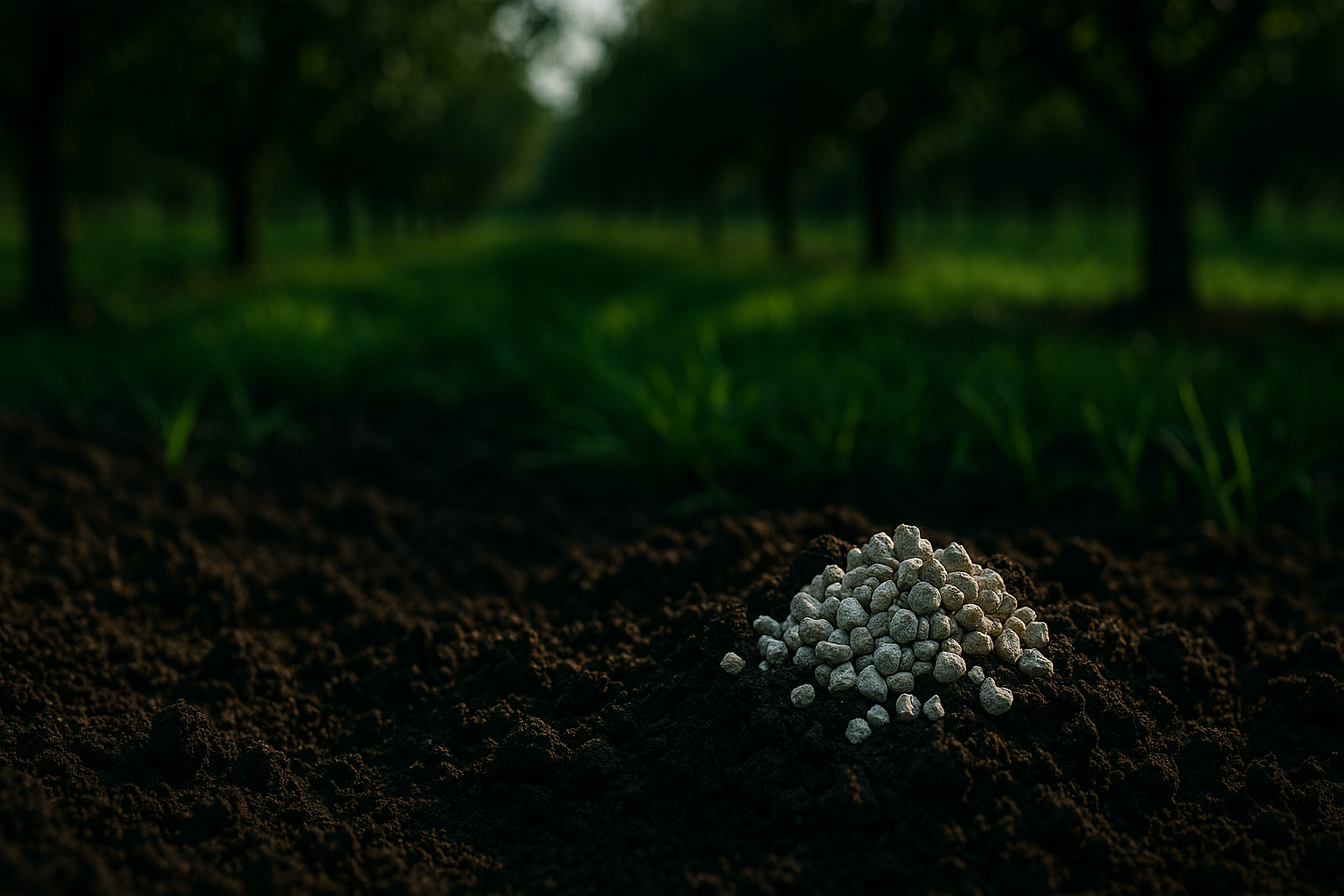
How orchard soil management differs from annual crops
Perennial fruit trees such as apple, pear, peach, and grape grow in the same spot for 20–30 years or more once planted. Unlike open-field annual crops whose soil is re-formed by tilling every year, an orchard means that once the root-zone soil is properly built, you must live with those conditions for decades. Because deep soil improvement is virtually impossible after planting, the soil physical-property design at the time of transplanting governs the vigor and yield of the tree over its entire lifespan.
Many orchards are established on sloped, sandy soils, so it is common for nutrients and moisture to leach rapidly below the root zone after irrigation or rainfall. Even when nitrogen and potassium application rates are increased, a large portion is lost underground before the crop can take it up, causing both higher fertilizer costs and groundwater nitrate contamination. In addition, moisture stress just before harvest directly affects fruit sizing and sugar content, so securing water-holding capacity becomes a key management point.
Why zeolite is considered in orchards
Natural clinoptilolite carries a permanent negative (−) charge generated when Al³⁺ substitutes for Si⁴⁺ in a framework of SiO₄·AlO₄ tetrahedra connected in three dimensions. This charge is neutralized by exchangeable cations (K⁺, Ca²⁺, Na⁺, NH₄⁺) located in the microporous channels (pore diameter 4.0–7.0 Å) inside the crystal, and their reversible exchange with cations in the soil solution is the cation exchange mechanism. Therefore, as long as the ammonium nitrogen (NH₄⁺) and potassium (K⁺) supplied by fertilizer carry a positive charge, clinoptilolite can hold them electrostatically. Conversely, negatively charged nitrate nitrogen (NO₃⁻) and phosphate are barely adsorbed in the unmodified state, so what zeolite directly holds in an orchard should be understood as cations such as NH₄⁺ and K⁺.
KMIZEOLITE clinoptilolite has a cation exchange capacity (CEC) of 1.6–2.0 meq/g (= 160–200 cmol⁺/kg), which is more than an order of magnitude higher than the CEC of typical sandy topsoil (often around 1–10 cmol⁺/kg). This difference is what creates the reinforcing effect in sandy, sloped orchards. He et al. (2002, Plant and Soil) reported that applying clinoptilolite to calcareous sandy soil significantly reduced ammonia (NH₃) volatilization (DOI: 10.1023/A:1021584300322). This is because the amount of NH₄⁺ held in the pores that shifts toward equilibrium as NH₃ and volatilizes decreases. In other words, it reduces losses of applied nitrogen escaping as gas or sinking underground, keeping it longer in the root zone.
At the same time, the porous structure, whose pore volume reaches about 50% of the framework volume, captures moisture by capillary force and raises water-holding capacity. Rahayu et al. (2019, Sains Tanah) reported that blending zeolite into a sandy root zone increases soil water retention and lowers the sodium adsorption ratio (SAR) (DOI: 10.20961/stjssa.v16i1.28132), and McConnell et al. (2001, HortTechnology) quantitatively demonstrated that nutrient retention and growth of container-grown plants improved in zeolite-amended substrates (HortTechnology 11(1):75). The two mechanisms (nutrient retention and water retention) combine to raise both irrigation efficiency and nutrient use efficiency (NUE).
Comprehensive reviews point in the same direction. Ramesh & Reddy (2017, Water, Air, & Soil Pollution) summarized that zeolite soil amendment improves water and nutrient retention and NUE (DOI: 10.1007/s11270-017-3649-1), and Jarosz et al. (2022, Applied Sciences) and Mondal et al. (2021, Agronomy) reported numerous cases in which natural zeolite enhances soil health, crop yield, and nutrient efficiency (DOI: 10.3390/app12010350 · DOI: 10.3390/agronomy11030448). However, most of these studies are annual, container-grown, or short-term field trials, so yield effects under perennial fruit-tree open-field conditions presuppose orchard-by-orchard trial-plot verification.
KMIZEOLITE's natural clinoptilolite, at 97% purity, is mined and processed at the Amargosa Valley mine in Nevada, USA. With a specific surface area of 40.0 m²/g, a pH stability range of 3.0–10.0, and a hardness of 4.0–5.0 Mohs, it remains stable without decomposing in acidic or neutral orchard soils alike. General safety for soil amendment use is based on the U.S. FDA GRAS (21 CFR 182.2729), and as it is OMRI Listed (KMI-10365), application can also be considered for organic orchards.
KMIZEOLITE key properties
| Property | Value |
|---|---|
| Clinoptilolite purity | 97% |
| Cation exchange capacity (CEC) | 1.6–2.0 meq/g |
| Specific surface area | 40.0 m²/g |
| Pore diameter | 4.0–7.0 Å |
| pH stability range | 3.0–10.0 |
| Hardness | 4.0–5.0 Mohs |
| Thermal stability | 700°C |
| Specific gravity | 1.89 |
| Bulk density | 45–54 lbs/ft³ |
| Certifications | OMRI KMI-10365, FDA GRAS (21 CFR 182.2729), TSCA, EN-71-3 |
Application examples of zeolite for orchard soil management
In orchards, the following methods are considered depending on the depth and timing of soil improvement. Prioritize deep amendment before planting, but in established orchards, partial improvement centered on the surface layer or drip-irrigation lines is realistic. The core of each method is to position the zeolite in the nutrient-uptake zone where fine roots are concentrated (the 0–30 cm surface layer around the canopy projection) to extend the time NH₄⁺·K⁺ takes to pass through and escape that zone.
- Planting-hole blending (at transplanting): A method of blending zeolite into the planting-hole backfill at about 5–10% by volume to raise root-zone CEC and water-holding capacity at the planting stage. It is the most effective timing for fruit trees, which are difficult to amend after planting, and once applied, the framework does not decompose (hardness 4.0–5.0 Mohs), so it works across the tree's entire lifespan.
- Surface application beneath the canopy: In established orchards, a method of broadcasting granular zeolite along the canopy projection perimeter and lightly raking it in to reinforce nutrient and moisture retention in the surface layer where fine roots are concentrated. It is a realistic alternative for mature orchards where deep backfill is impossible.
- Drip irrigation / fertigation support: A method of laying zeolite beneath the drip line so that applied nutrients are temporarily retained before leaving the root zone. It temporarily captures NH₄⁺ and releases it slowly during subsequent irrigation, buffering the leaching peak right after fertilization.
- Slow-release fertilizer carrier: A method of pre-adsorbing nitrogen and potassium onto zeolite so that nutrients are released gradually. This is the slow-release fertilizer carrier concept reviewed by Mondal et al. (2021) and Jarosz et al. (2022) and is suited to cationic nutrients (NH₄⁺·K⁺). (Loading the anion phosphate requires separate modification and is outside the scope of this page.)
- Trial / pilot application: A method of applying a small amount to some rows and comparing tree vigor and fruit quality against a control over 1–2 growing seasons to decide on adoption. Because effects in perennial fruit trees appear cumulatively and with a delay, observation over at least one growing season is recommended.
Recommended particle size and product specifications
In orchards, Fine Granule (30×50 mesh) is mainly considered for blending into planting-hole backfill, and Powder (100 mesh) for slow-release fertilizer coating or fine-fraction backfill reinforcement. For positions requiring water permeability, such as laying beneath drip irrigation, consider Medium Granule (14×40 mesh). Refer to the table below to select the product group that fits your use.
| Product group | Mesh | Particle size | Typical uses |
|---|---|---|---|
| Powder | 100 mesh or finer | <150μm | Pozzolan, feed, powder adsorption |
| Fine Granule | 30×50 mesh | 0.3–0.6mm | Water treatment, filtration, soil |
| Medium Granule | 14×40 mesh | 0.4–1.4mm | Filter beds, litter, bedding |
| Coarse Granule | 8×14 mesh | 1.4–2.4mm | Pools, de-icing, large-scale filtration |
| Extra Coarse | 4×8 mesh | 2.4–4.8mm | Packed beds, air scrubbers |
→ View products by mesh size · Application-based product selection guide
Pilot testing and on-site review points
When applying zeolite in the orchard soil field, be sure to check the following items together.
- Soil diagnosis first: Before application, analyze the CEC, pH, and texture (sandy/clayey) of the root-zone soil. The lower the CEC of a sandy orchard (often 1–10 cmol⁺/kg), the relatively greater the reinforcing effect of a material with CEC 160–200 cmol⁺/kg. In clayey orchards that already have sufficient CEC, the cost-effectiveness may be smaller.
- Confirm the target nutrient: What unmodified clinoptilolite directly holds are cations such as NH₄⁺ and K⁺. Anions such as nitrate nitrogen (NO₃⁻) and phosphate are barely adsorbed because of the negatively charged framework, so nitrogen management is most effective when linked with ammonium-form fertilizer and fertigation.
- Decide the timing: For new establishment, consider planting-hole blending; for established orchards, consider surface application beneath the canopy or laying beneath drip lines. This presupposes that fruit trees are difficult to amend deeply after planting.
- Design the blend ratio: Determine it within the range of 5–10% of the planting-hole backfill volume according to crop and soil texture, and first confirm the appropriate ratio with a trial plot. Excessive blending can change drainage and aeration, so increase it in stages.
- Link with fertilization: Zeolite does not replace fertilizer. As nutrient losses are reduced, readjust nitrogen and potassium application rates to avoid over-fertilization (returning part of the NUE improvement as a fertilizer reduction).
- Check regulations: For organic orchards, check whether it is OMRI Listed (KMI-10365); for general soil-amendment safety, check FDA GRAS (21 CFR 182.2729).
- Durability: Zeolite does not decompose in soil (hardness 4.0–5.0 Mohs, stable at pH 3.0–10.0), so a single application maintains its effect across multiple growth cycles of perennial fruit trees. He et al. (2002) reported reduced ammonia volatilization in sandy soil, Rahayu et al. (2019) reported improved water retention and SAR, and Ramesh & Reddy (2017) reported improved water and nutrient retention.
→ View TDS (Technical Data Sheet) · View MSDS (Material Safety Data Sheet)
Orchard Soil FAQ
What does adding zeolite to orchard soil improve?
The key is reinforcing root-zone nutrient retention and water-holding capacity. With a CEC of 1.6–2.0 meq/g (160–200 cmol⁺/kg), clinoptilolite uses cation exchange to hold applied ammonium nitrogen (NH₄⁺) and potassium (K⁺) and release them gradually, reducing leaching, while its ~50% pore-volume porous structure raises water retention. He et al. (2002) reported reduced ammonia volatilization in sandy soil, and Ramesh & Reddy (2017), Jarosz et al. (2022), and Mondal et al. (2021) reported improvements in water and nutrient retention, nutrient use efficiency (NUE), and crop yield. Note, however, that what it directly holds are cations such as NH₄⁺ and K⁺; anions such as nitrate nitrogen (NO₃⁻) are barely captured, and effects vary with soil texture and fertilization conditions, so a trial-plot comparison is recommended before adoption.
When and where is application most effective?
Because deep soil improvement is difficult after fruit trees are planted, blending 5–10% by volume into the planting-hole backfill at the time of transplanting saplings is most effective. For already-established orchards, consider broadcasting it over the surface beneath the canopy where fine roots are concentrated and lightly raking it in, or laying it beneath drip-irrigation lines.
Which particle size (mesh) is suitable?
Fine Granule (30×50 mesh) is generally considered for blending into planting-hole backfill, Powder (100 mesh) for slow-release fertilizer coating or fine-fraction reinforcement, and Medium Granule (14×40 mesh) for positions beneath drip lines that require water permeability. Please refer to the application-based product selection guide.
Does zeolite replace fertilizer?
No. Zeolite is not a fertilizer but a carrier and soil amendment that holds nutrients in place. As losses of applied nutrients are reduced, the appropriate use is to readjust nitrogen and potassium application rates to avoid over-fertilization. For organic orchards, check whether the material is OMRI Listed (KMI-10365).
Can I get a sample for testing?
Yes. KMIZEOLITE supports the provision of samples for evaluating real orchard application. On the sample request page, please leave your crop type, soil texture, and desired particle size.
Inquiries and sample requests
If you are considering applying zeolite in the field of orchard soil management, please contact us through the channels below.
Notice
Applicability may vary depending on site conditions, regulations, and test results. Before actual application, a test review tailored to the site conditions must be carried out in advance. Zeolite should be understood not as a cure-all for this field but as a material that supports existing processes.
Related pages
science Related Papers
These are academic papers addressing zeolite application in this field. Please refer to them when considering adoption.
- Application of Zeolite for Sustainable Agriculture: Water and Nutrient Retention
Ramesh, K. and Reddy, D.D. — Water, Air, & Soil Pollution, 2017 - Clinoptilolite zeolite reduces ammonia volatilization in calcareous sandy soil
He, Z.L. et al. — Plant and Soil, 2002 - The role of natural zeolites as soil amendments to increase crop yield and nutrient efficiency
Jarosz, R. et al. — Applied Sciences, 2022 - Zeolites Enhance Soil Health, Crop Productivity and Environmental Safety
Mondal, M. et al. — Agronomy, 2021 - Substrate Nutrient Retention and Growth of Container-grown Plants in Zeolite-amended Substrates
McConnell, D.B. et al. — HortTechnology, 2001 - Amendments on Salinity and Water Retention of Sand Base Rootzone and Turfgrass Yield
Rahayu, R. et al. — Sains Tanah - J. Soil Science and Agroclimatology, 2019
The papers above are reference material, and actual application requires separate review tailored to site conditions.