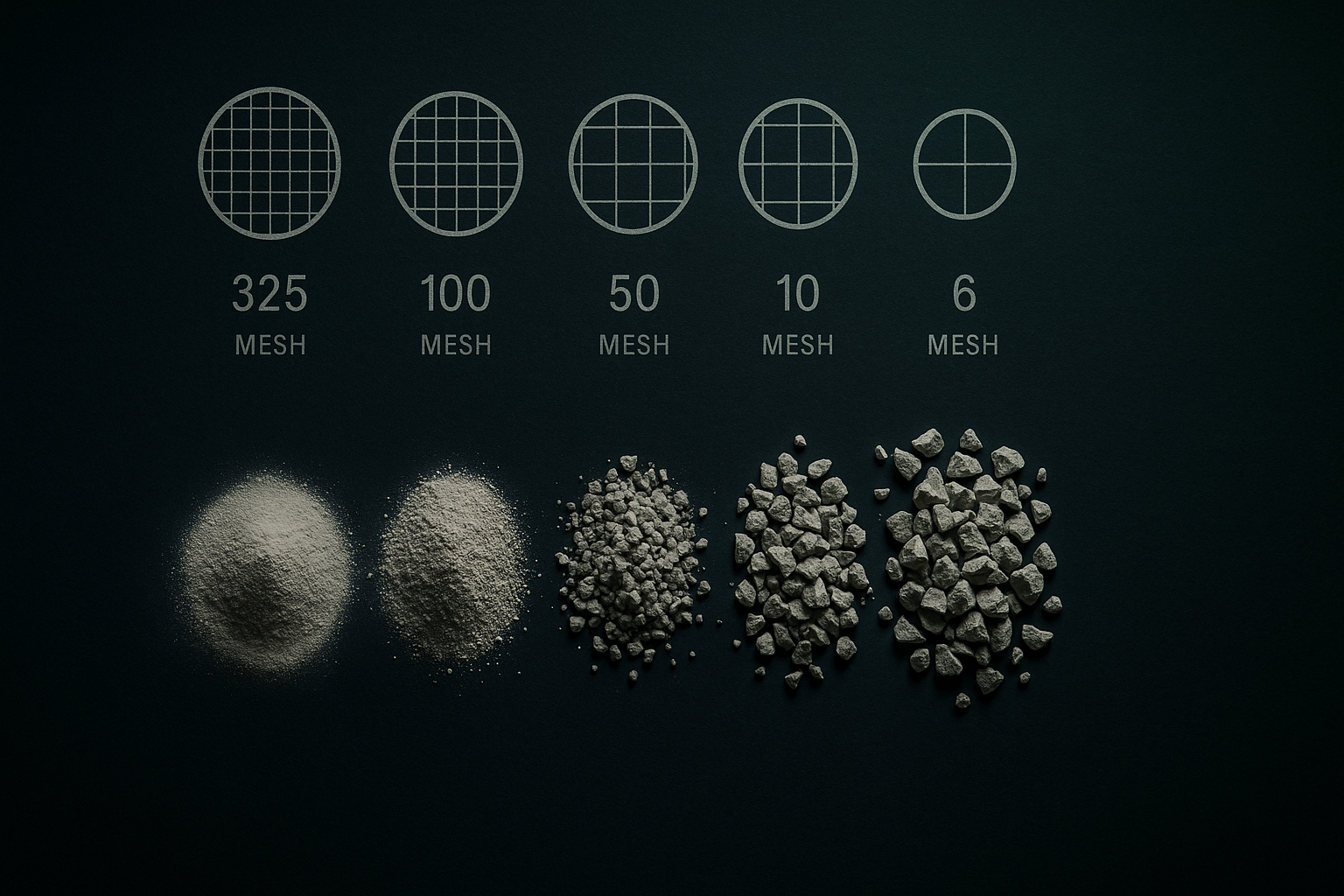
Particle Size Chart: A Guide to Measuring Particle Sizes by Industry
A particle size chart is an essential tool for accurately measuring and comparing the sizes of fine particles across a wide range of industries. In this article, we will look at the fundamental concepts of particle size measurement, the key particle size metrics, and examples of how they are applied in various industries.
Fundamental Concepts of Particle Size Measurement
Particle size is measured in micrometers (µm), and particle size analysis serves as a critical parameter in product manufacturing processes. Different industries use different measurement methods to analyze particle size. Such measurement is essential for product quality control and performance optimization. For example, in the pharmaceutical industry, particle size has a significant impact on a drug's solubility and bioavailability.
Key Particle Size Metrics
The metrics most commonly used to express particle size are as follows:
- d10 (DV0.1): The particle size that accounts for 10% of the total particle volume. This represents the size of the smallest particle group.
- d50 (DV0.5): The particle size that accounts for 50% of the total particle volume, also known as the Volume Median Diameter (VMD). This represents the medium-sized particle group.
- d90 (DV0.9): The particle size that accounts for 90% of the total particle volume. This represents the size that includes up to the largest particle group.
All of these metrics are based on volume percentage (volume %) and play an important role in understanding particle distribution and characteristics.
Particle Size Measurement Methods by Industry
Pharmaceutical Industry
In the pharmaceutical industry, particle size directly affects a drug's solubility and absorption rate. Accurate particle size measurement is therefore essential. Laser diffraction is generally used to measure particle size, providing fast and accurate results.
Chemical Industry
In the chemical industry, particle size is strictly controlled to improve catalyst efficiency. Nanoscale particle size analysis is carried out using advanced instruments such as electron microscopes.
Food Industry
In the food industry, particle size affects a product's texture and solubility. For example, in powdered beverages, particle size has a major impact on the rate of dissolution.
FAQ
-
Why is particle size important? Particle size is very important because it has a direct impact on product performance and quality.
-
How is particle size measured? Particle size is measured using various methods, primarily laser diffraction, electron microscopy, and sieve analysis.
-
What does the d50 value mean? The d50 value is the particle size that accounts for 50% of the total particle volume, representing medium-sized particles.
-
Why is particle size important in the pharmaceutical industry? Particle size affects a drug's solubility and absorption rate, thereby determining the drug's efficacy.
-
How is particle size used in the chemical industry? In the chemical industry, particle size is strictly controlled to improve catalyst efficiency.
Conclusion
A particle size chart is an essential tool for understanding and managing particle size across various industries. By selecting the appropriate measurement method according to the characteristics and needs of each industry, you can optimize product quality and performance.